If you source cookware materials, commercial cooking plates, or components for food-service equipment, you may frequently see terms such as tri-ply stainless steel, 3-ply stainless steel, fully clad, bonded base, SS-Al-SS, and multilayer cookware material.
These terms are often used interchangeably in marketing, but they do not always describe exactly the same product.
For an equipment manufacturer, understanding the construction behind the terminology is more important than simply seeing “3-ply” in a supplier specification. Layer materials, individual layer thicknesses, bonding quality, plate dimensions, and the final application all affect how a multilayer metal performs.
This guide explains what tri-ply stainless steel actually means and what OEM buyers should check when sourcing clad metal raw materials.
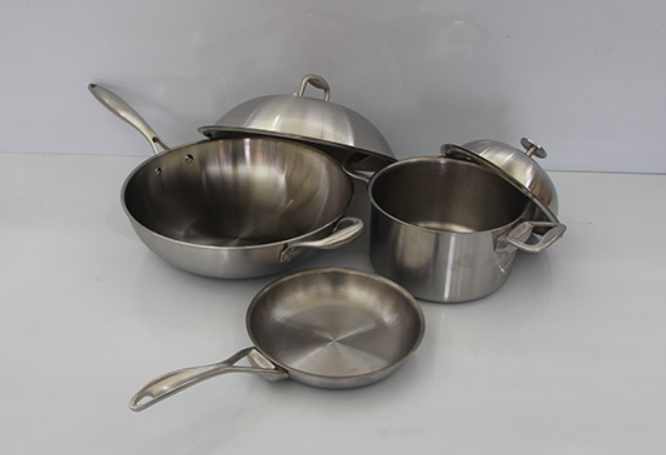
Tri-ply stainless steel is a composite metal construction made from three bonded metal layers.
A common configuration is:
Stainless Steel + Aluminum + Stainless Steel
The stainless steel layers provide durable exterior surfaces, while the internal aluminum layer contributes thermal conductivity.
The important word is bonded.
Tri-ply does not simply mean that three loose sheets of metal are stacked together. The layers are permanently joined so that they behave as one composite material during forming, heating, and use.
Major cookware manufacturers describe tri-ply in essentially the same way: stainless steel forms the external surfaces while aluminum is located between them as the conductive middle layer. In fully clad cookware, those layers extend through the body rather than appearing only in a separate bottom disc.
For OEM applications beyond finished cookware, the same multilayer principle can be applied to flat plates, circles, blanks, and cooking-equipment components.
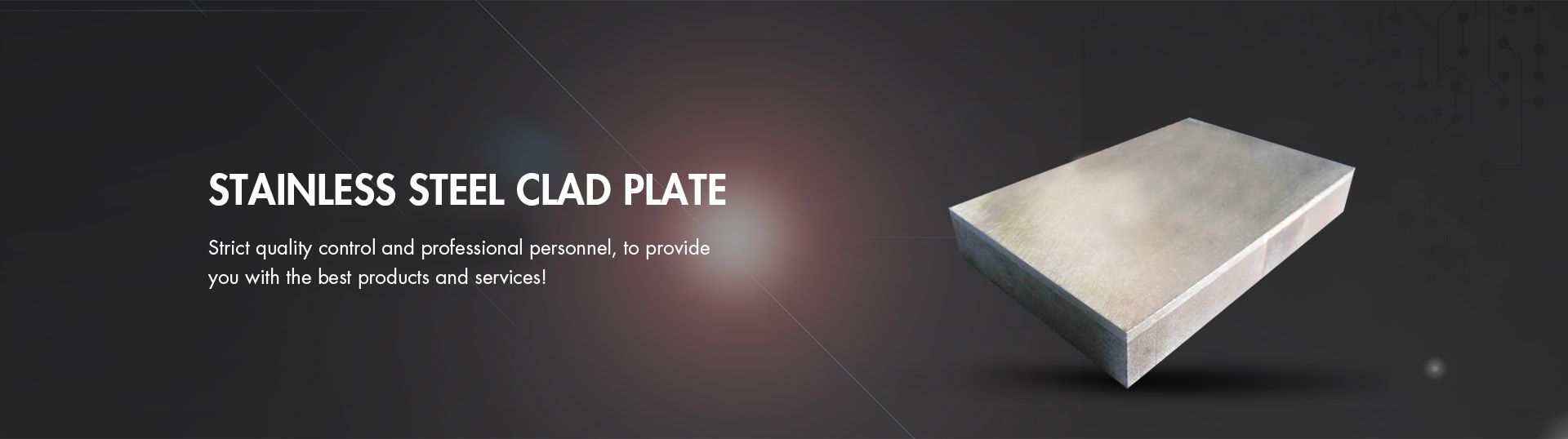
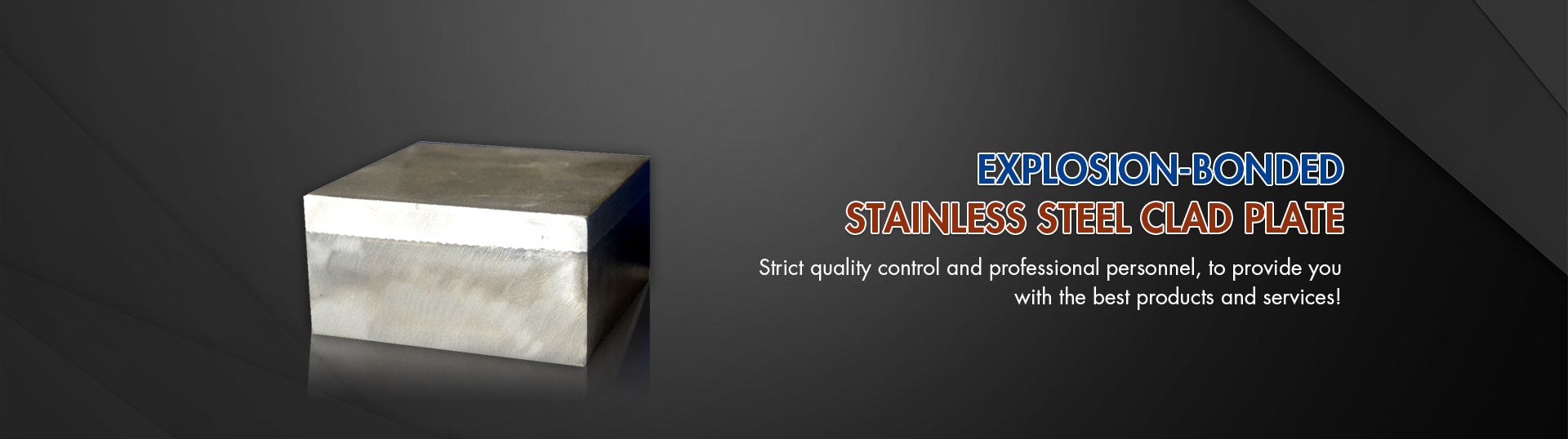
KLS supplies SS-Al-SS 3-ply stainless steel raw material for commercial griddles, teppanyaki equipment, flat-top grills, and other cooking applications.
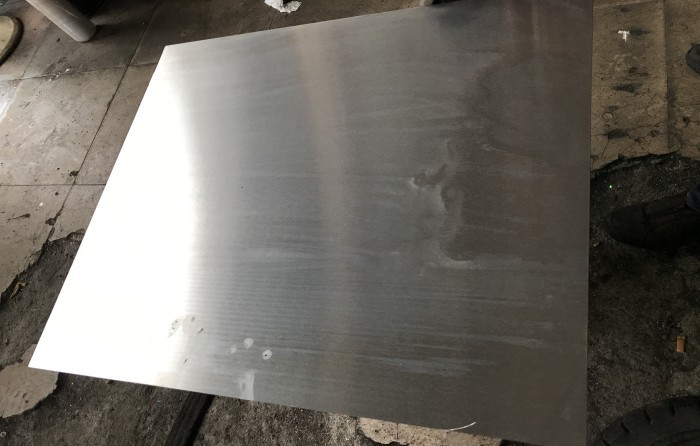
A typical SS-Al-SS structure contains three functional layers.
Position | Material | Main Purpose |
Top layer | Stainless steel | Cooking or exposed surface |
Middle layer | Aluminum | Conductive core |
Bottom layer | Stainless steel | Backing and structural surface |
However, knowing that a plate contains stainless steel and aluminum is only the beginning.
OEM buyers should also determine:
· Stainless steel grade
· Aluminum grade
· Total plate thickness
· Thickness of each individual layer
· Layer ratio
· Plate dimensions
· Surface finish
· Required fabrication process
· Heating method of the finished equipment
Two plates can both be marketed as “tri-ply stainless steel” and still have significantly different specifications.
No.
The expression “tri-ply” describes the number of layers, not a universal material specification.
For example, one tri-ply product might use:
304 stainless steel / aluminum / 430 stainless steel
while another might use:
304 stainless steel / aluminum / 304 stainless steel
These two structures can behave differently because 304 and 430 stainless steel do not have identical properties.
The appropriate configuration depends on the finished product.
For cookware designed for induction cooktops, manufacturers often use a magnetic stainless steel exterior. For a commercial griddle plate, the backing material may instead be selected according to the heating system, fabrication process, strength requirement, and equipment structure.
Therefore, professional buyers should not submit an RFQ that simply says:
“Need 3-ply stainless steel.”
A useful technical inquiry should specify the desired structure or describe the finished application clearly enough for the supplier to evaluate it.
The phrase fully clad is especially common in the cookware market.
For a saucepan or frying pan, fully clad generally means that the multilayer construction extends from the base through the sidewalls rather than being limited to a separate heat-distribution disc attached to the bottom.
That distinction is important for shaped cookware.
However, buyers sourcing flat griddle plates or raw clad sheets should interpret the terminology differently.
A flat commercial cooking plate does not have the same sidewall geometry as a frying pan. For these applications, the more useful questions are:
· Does the specified three-layer structure extend throughout the required cooking area?
· What are the individual layer thicknesses?
· Is the plate supplied as a full sheet, circle, or cut-to-size blank?
· Will later cutting or machining expose the core?
· How will the edges be processed in the finished equipment?
In other words, cookware terminology should not replace an engineering specification.
Another common source of confusion is the difference between tri-ply clad material and cookware with an encapsulated or bonded base.
An encapsulated-bottom pan normally has a primary vessel body and a separate multilayer heat-distribution section attached mainly to the bottom.
A fully clad pan incorporates its multilayer construction more extensively through the cooking body.
Both approaches can be useful, but they are not identical.
For raw-material buyers, this distinction highlights an important sourcing principle:
Ask what the multilayer metal actually is, rather than relying only on the finished-product marketing name.
If you manufacture cooking equipment, you may be purchasing composite plate rather than finished cookware. In that case, the drawing, layer configuration, thickness tolerance, dimensions, and downstream fabrication requirements are more valuable than consumer-facing terminology.
No single metal provides every property needed for every cooking application.
Stainless steel is valued for characteristics such as:
· Corrosion resistance
· Surface durability
· Cleanability
· Attractive appearance
· Suitability for many food-contact applications
Aluminum contributes a different property profile, especially its relatively high thermal conductivity and lower density.
Combining materials allows engineers to create a composite structure in which each layer performs a particular function.
This does not mean that a tri-ply structure is automatically better than every single-metal plate.
It means that material performance can be engineered through the layer combination.
The final result depends on the complete structure rather than the number of layers alone.
Not necessarily.
Five-ply and other multilayer constructions are widely marketed in the cookware industry, but simply increasing the number of layers does not guarantee better performance for a specific application.
A three-layer plate with an appropriately designed conductive core may be more suitable than a more complicated structure if it satisfies the required thermal, mechanical, weight, fabrication, and cost targets.
For buyers, questions such as these are more useful than asking whether 3-ply or 5-ply is universally better:
· What thermal behavior is required?
· What plate thickness can the equipment support?
· What type of heater is used?
· Will the plate be formed or remain flat?
· What surface grade is required?
· What is the expected production volume?
· What dimensional tolerance is required?
The best layer count is the one that supports the finished product design.
When evaluating a supplier, create a specification sheet before requesting mass production.
Clearly state the required metal sequence, such as SS304 / aluminum / stainless steel.
Do not evaluate only total thickness.
For example, two 10 mm composite plates may contain very different amounts of aluminum and stainless steel.
Specify the target total thickness together with acceptable tolerances.
Provide finished width, length, diameter, or blank dimensions.
KLS's multiple-layer cooker materials can be supplied for different cookware and commercial cooking-equipment applications.
Tell the supplier whether the finished equipment uses:
· Gas
· Electric resistance heating
· Radiant heating
· Induction or magnetic heating
· Another heating configuration
The heating system can influence backing-material selection and layer design.
Specify the required stainless steel grade and finish instead of using broad terms such as “food-grade stainless.”
Inform the material supplier if the plate will later undergo:
· Cutting
· Drilling
· Welding
· Forming
· Grinding
· Edge machining
· Polishing
The raw material must be suitable for the downstream manufacturing process.
Although many people first encounter the term “tri-ply” when shopping for frying pans or cookware sets, multilayer metal also has applications in commercial cooking-equipment manufacturing.
A flat SS-Al-SS plate can be used as raw material for:
· Commercial flat-top griddles
· Electric cooking plates
· Gas-heated griddles
· Teppanyaki equipment
· Restaurant cooking stations
· Hotel kitchen equipment
· Specialized food-processing heating surfaces
These products create different engineering demands from a household frying pan.
The cooking area may be much larger, the plate may operate for longer periods, and the equipment may use several heaters or burners beneath a single surface.
For this reason, OEM plate selection should be based on equipment-level requirements rather than simply copying a cookware specification.
Tri-ply stainless steel is best understood as an engineered three-layer metal system, not simply a premium cookware label.
The term tells you that three metals have been bonded together, but it does not tell you everything you need to know about the finished material.
For professional sourcing, the important questions are:
Which metals are used? How thick is each layer? What is the total thickness? How is the finished product heated? What dimensions and fabrication processes are required?
Once these questions are answered, tri-ply construction becomes much easier to specify correctly.
For commercial cooking-equipment manufacturers, evaluating the complete SS-Al-SS layer structure is more useful than selecting raw material based only on the words “3-ply stainless steel.”