Commercial griddle plate thickness has a major influence on cooking performance, but there is no single thickness that is correct for every flat-top grill.
A thicker cooking plate generally provides greater thermal mass and better resistance to sudden temperature drops when large quantities of cold food are placed on the surface. A thinner plate normally reaches operating temperature faster and requires less material, but it stores less thermal energy.
This is why commercial griddles may use different plate thicknesses depending on whether the equipment is designed for light-duty breakfast service, general restaurant cooking, high-volume burger production, teppanyaki, or continuous food-processing applications.
For equipment manufacturers, however, thickness should never be selected independently from plate material, cooking area, heater layout, layer structure, and required temperature uniformity.
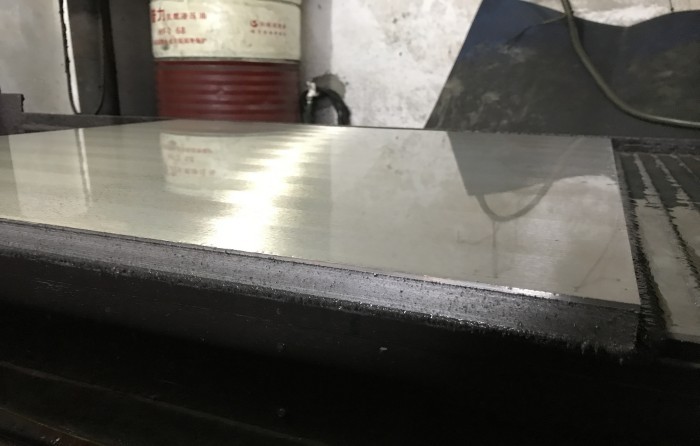
Conventional commercial steel griddles commonly use plates ranging from approximately 1/2 inch to 1 inch, depending on the equipment duty level.
A commonly seen rule of thumb is:
Conventional Steel Plate Thickness | Typical Duty Level | General Characteristic |
Around 3/8 in. | Light duty | Faster warm-up, lower heat reserve |
Around 1/2 in. | Light to medium commercial duty | Moderate thermal mass |
Around 3/4 in. | General commercial duty | Balance of heat storage and warm-up |
Around 1 in. | Heavy duty | High thermal mass for continuous production |
Heavy-duty manufacturers provide real examples of this approach. Star Manufacturing offers commercial electric griddles using a 1-inch polished steel plate, while Vollrath also specifies a 1-inch polished steel cooking plate on some heavy-duty gas griddles.
These examples help explain the relationship between thickness and duty level, but they should not be treated as a universal specification for every material structure.
A 1-inch solid steel plate and a multilayer stainless steel–aluminum plate of another thickness cannot be compared using thickness alone.
The main reason is thermal mass.
When a griddle reaches its set temperature, the cooking plate stores thermal energy.
Now imagine placing a large quantity of refrigerated hamburger patties onto that surface.
The cold food absorbs heat from the plate.
If the cooking plate has very little thermal reserve, its surface temperature can fall rapidly. The heating system then has to restore the lost energy before the surface returns to its operating range.
A thicker steel plate generally stores more heat, helping it resist this temperature drop.
This can support:
· More stable searing
· Better batch-to-batch consistency
· Reduced temperature collapse under heavy loading
· More predictable performance during peak service
However, increasing thickness also has disadvantages.
No.
More thickness normally means more metal has to be heated.
That may lead to:
· Longer preheat time
· Greater equipment weight
· Higher material cost
· More demanding structural support
· Different thermal-expansion behavior
· Greater energy input before the plate reaches operating temperature
A very thick plate may be useful in a high-volume dinerproducing burgers continuously, but unnecessary for a light-duty café that uses its griddle intermittently.
The goal is not to select the thickest possible plate.
The goal is to create the right relationship between heat input, thermal storage, temperature response, and equipment duty cycle.
This distinction is important.
A thick plate can store substantial energy, but temperature recovery also depends on how quickly the heating system can replace energy lost during cooking.
Recovery performance is influenced by:
· Burner or heater output
· Distance between the heat source and plate
· Heater spacing
· Temperature-control design
· Sensor position
· Plate material
· Plate thickness
· Cooking load
· Required operating temperature
For example, simply installing a thicker plate on an underpowered heating system may increase preheat time without delivering the desired recovery performance.
Likewise, adding more burner power beneath a poorly designed plate can create concentrated heating zones rather than uniform cooking.
Plate thickness therefore has to be engineered together with the heating system.
Many commercial griddle thickness recommendations found online refer to solid polished steel or carbon steel plates.
This matters because different metals transfer and store heat differently.
A manufacturer evaluating a multilayer cooking plate should not automatically copy a conventional 3/4-inch or 1-inch solid-steel specification.
An SS-Al-SS clad plate for commercial griddles, for example, contains stainless steel external layers and an aluminum core.
Because the internal structure differs from solid steel, performance depends on:
· Total plate thickness
· Aluminum-core thickness
· Stainless steel layer thickness
· Layer ratio
· Plate size
· Support design
· Heater configuration
Therefore, total thickness alone is not enough to define a clad griddle plate.
Suppose two suppliers offer a 10 mm three-layer plate.
At first glance, the specification appears identical.
But Plate A might contain a relatively thick conductive core, while Plate B might allocate more of the total thickness to its stainless steel layers.
Even though both products are 10 mm thick, they are not necessarily thermally equivalent.
This is why OEM buyers should request both:
Total thickness and individual layer thickness or layer ratio.
When sourcing multi-layer materials for cooking equipment, providing the intended cooking application also helps determine which structure should be evaluated.
A larger cooking plate creates different mechanical and thermal requirements from a smaller countertop unit.
As plate width and length increase, manufacturers may need to consider:
· Flatness
· Structural support
· Thermal expansion
· Temperature variation from center to edge
· Number of burners or electric elements
· Heating-zone arrangement
· Deflection under its own weight
· Fabrication and mounting method
For this reason, a plate thickness that works for a compact 24-inch griddle cannot automatically be applied to a much larger teppanyaki station.
Large plates require an equipment-level design review.
High-volume griddles repeatedly receive cold food during service.
Examples include:
· Burger restaurants
· Diners
· Hotel breakfast kitchens
· Institutional cafeterias
· High-output catering operations
For conventional steel griddles, heavier 3/4-inch to 1-inch plates are commonly associated with medium- to heavy-duty operation because the additional thermal mass helps maintain cooking conditions under repeated loading.
But OEM designers should still evaluate burner capacity and zone layout rather than specifying thickness from a generic chart alone.
A high-volume griddle requires a balanced thermal system.
Electric heating elements generally introduce heat at defined locations beneath the plate.
For these products, manufacturers need to consider:
· Element spacing
· Wattage
· Contact or gap between element and plate
· Sensor location
· Cooking-zone width
· Plate conductivity
· Total plate thickness
A thicker plate may increase thermal stability but also increase warm-up time.
If temperature uniformity is a major objective, the internal material structure may be just as important as total thickness.
Gas burners create another heat-input pattern.
Flame and hot combustion gases transfer heat into specific areas beneath the plate. Burner arrangement therefore affects the surface-temperature profile.
Manufacturers should evaluate plate thickness together with:
· Number of burners
· Burner spacing
· Burner geometry
· BTU input
· Distance from burner to plate
· Heat shielding
· Control-zone design
Adding plate thickness cannot completely compensate for poor burner distribution.
Teppanyaki plates are often larger and heavier than ordinary countertop griddles.
Some equipment designs prioritize:
· Structural rigidity
· Long heat-holding capacity
· High thermal mass
· Magnetic heating
· Large cooking surfaces
For these applications, a stainless-clad carbon steel construction may be selected rather than an aluminum-core design.
KLS also manufactures stainless steel clad carbon steel teppanyaki plate in configurations such as 8+2 mm, 10+2 mm, and 18+3 mm, illustrating how base-metal and clad-layer thickness can be specified separately.
This is another reason that “What thickness should a griddle plate be?” cannot be answered with one universal number.
The material structure matters.
When requesting a custom griddle plate, provide as much application information as possible.
A useful RFQ should include:
Provide length, width, diameter, or drawing dimensions.
State whether the equipment is gas, electric, radiant, induction, or another configuration.
If a thickness is already established, include it together with tolerance requirements.
For clad plate, specify the desired stainless steel, aluminum, or carbon steel combination.
Provide a target ratio if your engineering team has already validated one.
Describe typical operating temperature and expected duty cycle.
Specify stainless steel grade and surface finish.
Explain whether the supplier should provide full plates, circles, rectangular blanks, or other cut shapes.
Prototype requirements and mass-production quantities may involve different manufacturing considerations.
For conventional commercial steel griddles, industry examples commonly place 3/4-inch and 1-inch plates in medium- to heavy-duty applications, while thinner plates are more often associated with lighter-duty equipment.
But that is only a starting reference.
For an OEM designing a clad-metal griddle plate, the correct specification should be based on:
material structure + total thickness + layer ratio + cooking area + heater layout + equipment duty cycle + structural support.
That formula is much more useful than copying a thickness number from an existing restaurant griddle.
Griddle plate thickness directly influences heat storage, preheat behavior, recovery under load, weight, and mechanical stability.
Thicker plates can provide greater thermal reserve, which is valuable in continuous high-volume cooking. Thinner plates can offer faster warm-up and lower weight.
But thickness should never be evaluated by itself.
For commercial griddle manufacturers using multilayer clad materials, 10 mm of composite plate is not necessarily equivalent to 10 mm of solid carbon steel, just as two 10 mm composite plates with different layer ratios may not perform identically.
The correct griddle plate therefore starts with the finished equipment design—not with a universal thickness chart.